Shop By Category
Related Links
Corner Rounder: Industrial 3" Radius for 1/8" Aluminum
-
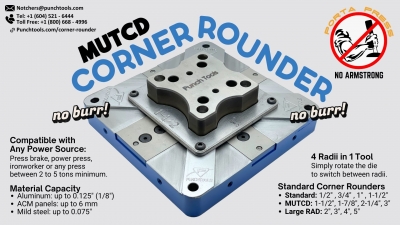 MUTCD Corner Rounder
No “Armstrong” Needed: The New Standard for 1/8" Aluminum Corner Rounding
In fabrication shops across the country, there’s an old-school rule for heavy-duty plate: if you want to punch through 1/8" (.125) structural aluminum, you need a "Strong Arm." We call it the Armstrong Method—where the operator has to grab a long manual lever with both hands and throw their entire body weight into it just to get a clean shear.
We see this most often when shops try to use a standard Arbor Press for corner rounding. While an Arbor Press is a shop staple, using one to force a radius through thick plate is exhausting, inconsistent, and a long-term risk for shoulder and back strain.
At Punch Tools, we’ve engineered a solution that handles the heavy lifting for you.
1. The Power: Punching 1/8" Without the Pull
Most desktop corner rounders are built for thin sign blanks (.040" or .063"). Try to pull (.125") or 1/8" aluminum through those, and the "Armstrong" method usually results in a jammed blade or a strained back.
Our Corner Rounder is designed with a high-leverage mechanical advantage specifically for structural alloys.
-
Effortless Shearing: We’ve optimized the handle geometry and blade shear angle so the machine does the work, not the operator’s joints.
-
Burr-Free Results: No manual grinding or sanding is required after the punch, saving you even more shop time.
-
Inclusive Shop Floor: Because it doesn't require "Armstrong" strength to pull the lever, any operator can maintain high production speeds and 100% accuracy all day long.
2. The Geometry: Why the 3-Inch Radius Matters
If you are working on Florida Department of Transportation (FDOT) projects or following MUTCD guidelines, you know that a standard 1" or 1.5" radius won't cut it for large-scale infrastructure.
A 3-inch radius is the "Gold Standard" for:
-
Wind-Load Safety: Larger radii on overhead signs reduce wind resistance and vibration, critical for Florida's high-wind environments.
-
Public Safety: For pedestrian bridges and handrails, a 3" radius is the ultimate protection against lacerations.
-
Coating Longevity: Sharp corners cause powder coating and anodizing to "thin out" at the edge. A wide 3" radius ensures a uniform coat, preventing the salt-air corrosion that leads to structural rejection.
3. Efficiency vs. The Grinder
If your shop is currently using a bandsaw to rough-cut corners and a hand-grinder to finish them because your current rounder "can't handle the thick stuff," you are losing money on every part.
-
The Manual Way: 5 minutes of cutting, grinding, and breathing aluminum dust.
-
The Punch Tools Way: 2 seconds for a perfect, 100% consistent, FDOT-compliant radius.
Upgrade your shop floor. Retire the Armstrong method.

PTI Punch Tools Inc
11-211 Schoolhouse Street
Coquitlam, BC, Canada. V3K4X9
604-521-6444 | 1-800-668-4996

© 2026 PTI Punch Tools Inc. All rights reseved
Powered by Digit Art Designs Ltd.
